
The Royal Palace of Milan, formerly known as the Palazzo del Broletto Vecchio, stands in Piazza Duomo beside the Milan Cathedral. The earliest records of this palace date back to the 10th century, when it housed the city’s seat of government. Over the following centuries, under the **rule of the Visconti and Sforza families**, the complex was transformed into the true political and administrative centre of the city.
It was during Austrian rule that the Palace became the focus of extensive restoration work, both externally and internally. In particular, artists of the calibre of Andrea Appiani, Pelagio Pelagi and a young Francesco Hayez were commissioned to **enhance the interiors**. Unfortunately, during the Second World War the Palace suffered significant bombing damage that destroyed much of its original furnishings and artworks.
Elegant and grand, the Royal Palace now presents itself as a true masterpiece of **neoclassical architecture**. This is undoubtedly one of the essential stops during a visit to the city, as not only have many of its interiors been restored to their former glory but it also regularly hosts **major international exhibitions**.

Beyond hosting important temporary exhibitions, the **Royal Palace** of Milan is one of the finest testimonies to the various dynasties that have ruled the city. In particular, its interiors chronicle the **different eras** that have shaped this noble structure (and Milan more broadly). The main periods that have defined the Palace are: the neoclassical, Napoleonic, restoration and Italian unification eras.
Also known as the Rotunda Room, the **Hall of Ministers** is one of the most captivating rooms in the Palace. Sadly, the hall sustained considerable damage from the bombardments of 1943, so what we see today is a reconstruction. The room was originally created during the **Napoleonic period** and it was Napoleon himself who ordered it to be decorated in gold, white and turquoise.
Following Italian unification the room changed purpose and **the House of Savoy** ordered various modifications, including the addition of red velvet. The reconstruction has preserved original features such as the Empire-period fireplace with gilded oak leaves and the pair of gilded torch-shaped ornaments with griffins.
As home to the courts of Europe’s major royal families, the Royal Palace has had several **throne rooms** throughout its history, changing in appearance and location depending on the reigning sovereign. The most important room, and the one best preserved to this day, is certainly the one commissioned by **Napoleon Bonaparte** for his coronation as King of Italy in 1805. Today only parts of the sumptuous ceiling decorations are visible.
The Throne Room was characterised by gold and white colours, to which Napoleon chose to add green, a colour long associated with Italy. Unfortunately, all that remains to be seen is a preparatory drawing of the **gilded throne with baldachin** designed by architect Luigi Canonica, which once stood at the centre of the room. The remaining original furnishings are now preserved at the Museum of the Royal Villa at Monza.
The **Left Antechamber** preceded the State Apartment, which comprised the rooms used for court activities. On the walls we can still admire refined decorations, most likely executed by pupils of Giocondo Albertolli’s school, and two **important paintings** from the Palace’s collections.
On the eastern wall is the “Portrait of Lady Venetia Digby as an Allegory of Prudence” by Flemish painter Antoon Van Dyck, while on the northern side you can see the “Portrait of Empress Maria Theresa of Austria”, by an unknown artist.
The Royal Palace boasts **three Tapestry Rooms**, so named because in the 18th century they were designed to display a series of tapestries depicting the myth of Medea and Jason. The version of the myth represented is that from **Ovid’s Metamorphoses** (specifically Book VII), with each room featuring different episodes that together narrate the entire myth.
On the main floor of the Palace stands the **Hall of Caryatids**, named for the presence of 40 caryatids sculpted by Gaetano Callani. The hall was built around 1776 during Austrian rule, on the site of a former theatre, and was designed as a ballroom or festive hall. At the time it was truly sumptuous and elegant, and important events and celebrations were held here.
Regrettably, the hall suffered severe damage during the Second World War bombardments, which resulted in the loss of many decorations and much of its neoclassical interior. The hall has now been converted into an **exhibition space** that hosts exhibitions and events.
**Tickets can be purchased** at the box office on site or online. Although online booking is not mandatory, it is highly recommended to avoid queues. Especially at weekends and during particular exhibitions, visitor numbers can be very high and entry without reservation cannot always be guaranteed.
The **ticket types** for entry to the Royal Palace are:
The Royal Palace is **open daily** from Tuesday to Sunday from 10:00 to 19:30. Monday is closed.
On Thursday the Palace has extended opening hours and closes at 22:30.
On public holidays (1 January, 1 May, 2 June, 25 December) opening hours may vary.
The **Royal Palace** is located in Piazza del Duomo in Milan and the best way to get there is certainly **by metro** thanks to the Duomo stop served by lines MM1 and MM3.
You can also reach the destination using **bus and tram lines**:
It is not advisable to reach the Palace **by car** as it is located in a limited traffic zone with limited parking availability.
Various sources indicate that since the 10th century there has been a palace in this area serving as the seat of the city’s government. With the rise of the signorie, the Palace became an even more important **centre of political and administrative power**, first under the Torrioni family and later under the Visconti and Sforza. It was, however, under Gian Galeazzo Visconti, the first Duke of Milan, that the building acquired the name **Palazzo Ducale (Ducal Palace).**
In the mid-16th century, under Spanish rule, Governor Ferrante Gonzaga renamed it Palazzo Gonzaga, whilst his successor, Antonio de Guzman, carried out important modifications to both the interior and exterior spaces. Internally, the **first theatre in Milan** (1594) was built, which was later demolished in the 18th century to make way for the construction of the Teatro alla Scala.
However, the Palace’s current appearance and its **period of greatest splendour** came during Austrian rule, when the complex was intended as a venue for court life. Under architect Giuseppe Piermarini the building acquired a new **neoclassical style** whilst the magnificent Hall of Caryatids, a truly splendid ballroom, was created inside. In 1805, when Milan was under French rule, important artists such as Andrea Appiani and Francesco Hayez were brought to the Palace.
With the proclamation of the **Kingdom of Italy**, the Palace became property of the House of Savoy but lost some of its role and importance as it was used only for state occasions. After the First World War the complex was transferred from the Savoy family to the Municipality of Milan but, unfortunately, during the Second World War it suffered **significant bombardment damage** that harmed much of its interior. Subsequently, in the 1950s, the Municipality of Milan decided to give it new life by restoring it as an important cultural centre. Thus the Royal Palace became a major museum venue that has hosted exhibitions by great artists such as Van Gogh and Picasso.
Palazzo Reale is located in central Milan, to the right of the Duomo and directly opposite the Galleria Vittorio Emanuele II.


 Hotel
Hotel  Budget accommodations
  Apartments
  Family Hotel
 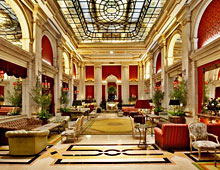 Luxury Hotel
  Resorts