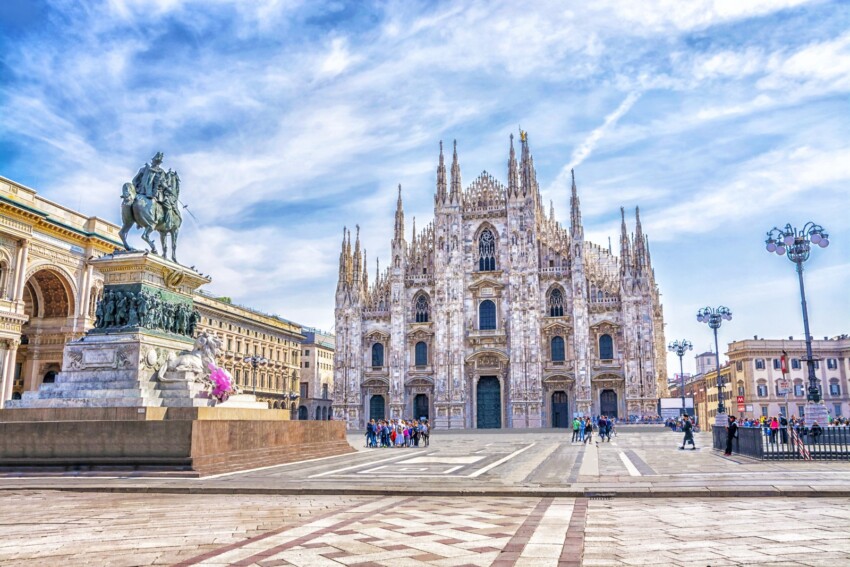
The Milan Cathedral, also known as the Metropolitan Cathedral of the Nativity of the Blessed Virgin Mary, is one of the city’s iconic buildings and stands in its namesake square in the heart of Milan. An unmissable stop for all visitors to the city, the Cathedral is a magnificent example of Gothic architecture and has been a hugely important building throughout Milan’s history.
Construction of the Cathedral began towards the end of the 14th century when the Duke of Milan Gian Galeazzo Visconti wanted to give the city a church that would rival those built in other European capitals and express the ambitions of his State. Work on the Cathedral continued for over four centuries, and the façade wasn’t completed until 1805 for Napoleon Bonaparte’s coronation as King of Italy.
Majestic, imposing and steeped in history, Milan Cathedral with its beautiful statue of the Madonnina is the attraction that perhaps more than any other draws tourists and pilgrims from around the world every single day. Arriving in Piazza Duomo and standing before the magnificent façade is an emotional moment, even for the people of Milan. This spectacular architectural masterpiece boasts 164 large windows, 135 spires, 410 corbels and 746 small corbels.
Best-selling tickets and tours in Milan
Things to do inside Milan Cathedral

The Cathedral is a true architectural masterpiece that has been worked on over time by not only famous architects but also master craftsmen from different regions. A distinctive external feature, beyond its Gothic verticality, is the extraordinary abundance of sculptures created by artists from Lombardy, Germany, Bohemia, France, Tuscany, Venice and the Campione region. Externally, the façade was created in white Condoglia marble at Gian Galeazzo Visconti’s behest and features five bronze entrance portals with high reliefs depicting episodes from the Virgin Mary, Jesus Christ, Sant’Ambrogio and the famous Edict of Constantine.
Internally, the Cathedral has a Latin cross layout with the main body characterised by five naves that extend 148 metres (from the main entrance to the choir). The transept, meanwhile, has three naves and at the intersection of its arms stands the tiburio. The naves feature 52 polystyle columns decorated with statues supporting ribbed vaults. The presbytery is surrounded by an ambulatory and two sacristies stand on either side. The presbytery we see today dates from the mid-16th century and the decorations were commissioned by Carlo Borromeo and completed by architect Pellegrino Tibaldi.
Cathedral Organ
From the very beginning, Milan Cathedral has always had a pipe organ. Currently, three can be found inside the church: the main organ, the choir organ and the crypt organ.
It is in particular the main organ that is considered the largest in Italy and the second in Europe in terms of the number of pipes and registers. The instrument was built by the firms Mascioni of Cuvio (Varese) and Tamburini of Crema in 1938 at the behest of Benito Mussolini. The organ features 15,800 pipes, the tallest measuring over nine metres whilst the smallest measures just a few centimetres.
Cathedral Terraces

The Cathedral Terraces are an absolute must-do as from up there you can enjoy a splendid view over the city and the Madonnina. The terraces can be reached on foot (by climbing the 200 steps) or via a convenient lift. The terrace area covers over 8,000 sq m and from here you can admire the spires, pinnacles, arches and numerous statues in all their beauty just a few metres away. Here you’ll also find the Carelli spire, considered the oldest on the Cathedral as it dates from around the end of the 14th century, and the tiburio built by Giovanni Antonio Amadeo between the late 15th and early 16th centuries.
The Madonnina
Installed on 30 December 1774, the Madonnina of Milan Cathedral is the highest point of the church and the protective figure of Milan. The statue, standing 4.16 metres tall, was designed by sculptor Giuseppe Perego and cast by goldsmith Giuseppe Bini.
According to an ancient tradition, no building in the city could be taller than the Madonnina, though in reality this old belief has since been superseded as the Pirelli Skyscraper, home to the Regional Council, measures 127 metres and is therefore taller than the 108 metres of the Madonnina. During the Second World War the Madonnina was long covered with fabric to prevent it from serving as a reference point for air raids.
Cathedral Treasury Museum
The Cathedral Treasury Museum is located on the ground floor of the Royal Palace. Inside you can admire the Cathedral’s Treasure, which houses an extensive collection of religious objects and goldwork items used by the cathedral’s religious staff until the 17th century.
The tour then continues with a discovery of the Cathedral’s history through the centuries, from its foundation in 1386 to the 20th century. The statues, stained glass, paintings, tapestries and sketches reveal how this was the fruit of patient, centuries-long work by hundreds of artists and craftsmen from different regions and periods.
Admission tickets for Milan Cathedral
To enter Milan Cathedral, various ticket types are available:
- Cathedral Pass with Lift Access (allows entry to the Cathedral, Terraces, Cathedral Museum, San Gottardo Church and archaeological area)
- Cathedral Pass with Stairs Access (allows entry to the Cathedral, Terraces, Cathedral Museum, San Gottardo Church and archaeological area)
- Culture Pass (allows entry to the Cathedral, Cathedral Museum, San Gottardo Church and archaeological area)
- Cathedral only
- Cathedral Museum
- Terraces only with Lift Access
- Terraces only with Stairs Access
Given the large number of visitors every day, we recommend purchasing your preferred ticket directly online; below we present the most popular options.
Skip-the-line ticket for Cathedral + Terraces
This is the best-selling ticket, covering all areas of Milan Cathedral, namely a visit to the cathedral itself, its terraces, the museum and the archaeological area.
Cathedral only or Terraces only tickets
If you’d instead prefer to access just the Terraces, or only the Cathedral, choose the ticket that suits you best from those below and save a little money.
Guided tour
The best option for visiting the Cathedral is certainly with a guided tour. For just a few euros more you’ll have an official guide at your disposal who will show you the history and all the interesting facts about the Cathedral.
Free entry with the Milan Pass
Entrance to the Cathedral, Museum, Terraces and archaeological area is free when you purchase the Milan Pass, Milan’s city card which guarantees you free access to the city’s main museums, including tickets for La Scala and other Milan attractions. It’s valid for 48 hours and includes transport plus many activities and discounts at businesses.
Opening times
The opening times for the Cathedral and Terraces are: daily from 9:00 to 19:00, with last entry at 18:10.
The Cathedral Museum is instead open with the following times: Tuesday to Sunday 10:00–19:00. Closed Mondays.
How to reach Milan Cathedral
The best way to reach the Cathedral is by public transport. By metro, the closest station is called Duomo. Here, the MM1 and MM3 metro lines converge.
You can also reach the destination using bus and tram lines:
- by tram you can take lines 2, 12, 14, 16, 19, stopping at Duomo station
- by bus you can take line 54, stopping at Duomo station
It’s not recommended to reach the Cathedral by car as it’s located in a limited traffic zone with few car parks.
History of Milan Cathedral

The history of Milan Cathedral begins before 1386 when Archbishop Antonio de’ Saluzzi wanted to build a great cathedral in the city that could accommodate all the faithful of the time. To do this, the old Cathedral of Santa Maria Maggiore, the winter cathedral and the Basilica of Santa Tecla were demolished. In those years, the Duke of Milan Gian Galeazzo Visconti had, however, a more ambitious project in mind for Milan, which was to be a capital on a par with other European cities. For this reason, he chose to build the new religious building in Candoglia marble according to late Gothic architectural forms.
Gian Galeazzo granted substantial subsidies and tax exemptions for the marble production: every block was exempt from any transit tax. The first chief engineer was Simone d’Orsenigo who, assisted by other Lombard masters, began work in 1388 building the perimeter walls. The construction project for Milan Cathedral then continued with the construction of the apse (which is the oldest part) and was completed almost four hundred years later with the façade.
Over the years, the city’s best architects have worked here, such as Giovanni Solari, Filarete (who also worked on the Sforza Castle), Lelio Buzzi, Carlo Buzzi and the Quadri. The work was concluded only at the beginning of the 19th century at the request of Napoleon Bonaparte, who held his coronation ceremony as King of Italy inside the Cathedral on 6 May 1805.


 Hotel
Hotel  Budget accommodations
  Apartments
  Family Hotel
  Luxury Hotel
  Resorts