
Look for accommodation in this area?
Click here to see all the facilities available in this area.

Cosmopolitan, international and elegant Milan is often known as the “capital of Italian fashion”. As the capital of Lombardy and Italy’s financial hub, Milan is a city that many underestimate because they don’t know its immense historical and architectural heritage.
The city was founded around 590 BC by the Celts and then became, thanks to its strategic location, a fundamental city during Caesar’s campaigns for the conquest of Gaul. Known as “Mediolanum“, between 58 BC and 50 BC Milan was a centre of Cisalpine Gaul that held an important military and economic role. With the fall of the Roman Empire, the city underwent various occupations by barbarians until the late Middle Ages, when it became the domain first of the Visconti family and then the Sforza.
It was precisely during the rule of the Visconti and Sforza that some of Milan’s most important buildings were constructed, which we can still admire today (such as Sforza Castle), and some of the most celebrated artists created works among the most famous in the world. Among these, mention must be made of Leonardo da Vinci’s The Last Supper in the Church of Santa Maria delle Grazie, where Bramante also worked, which was proclaimed a UNESCO World Heritage Site.
After being dominated by the Spanish, French and Austrians, the city became part of the Kingdom of Italy and between the 19th and 20th centuries Milan experienced exceptional industrial development. In 1906, Milan also hosted the Universal Exposition, an event it hosted again in 2015.
The historic centre of Milan, which was rebuilt at the beginning of the 20th century, holds much of the artistic and architectural heritage. The symbol of the city is certainly the Milan Cathedral, which is located near the Galleria Vittorio Emanuele II, home to all who love shopping.
In Milan, you mustn’t miss a visit to the famous La Scala Theatre and Sforza Castle. After a day exploring the city, it’s time to relax and head to the Navigli area, a part of Milan full of bars and restaurants where you can enjoy the famous “Milanese aperitivo”.
Today Milan is not only an important international commercial and industrial centre, but also a sought-after tourist destination thanks to its artistic and cultural heritage and its numerous boutiques that captivate shopping enthusiasts.
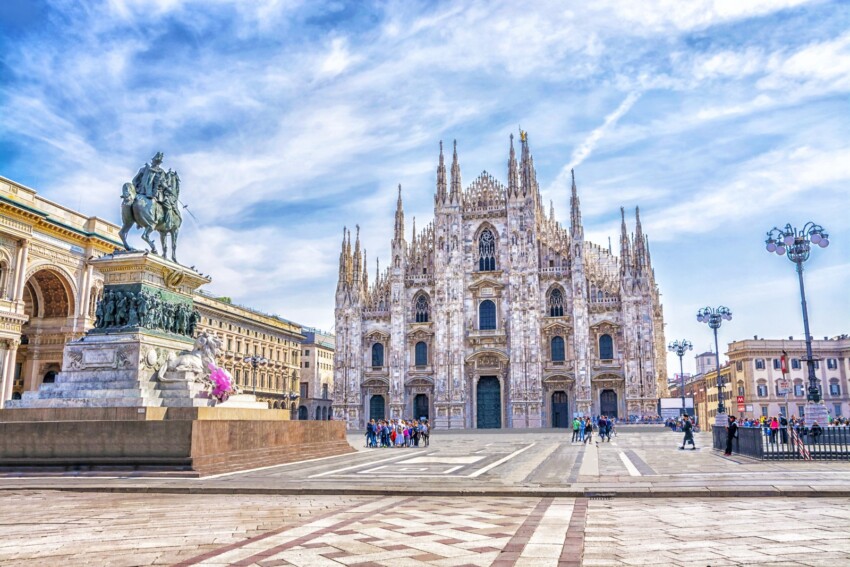
The Milan Cathedral, also known as the Metropolitan Cathedral of the Nativity of the Blessed Virgin Mary, is located in the piazza of the same name and is considered the largest church in our country and the third largest in the world by area. The Cathedral stands on the site where two other religious buildings once stood, which were destroyed to make way for the new church. Work on the Cathedral’s construction was carried out in several phases over a historical period spanning from the 14th to the 19th century.
The Duke of Milan Gian Galeazzo Visconti initiated the construction of a church that was meant to rival the greatest and most majestic cathedrals in Europe. For this reason, he chose to build the Cathedral using the prized marble from Candoglia in late Gothic style. Over time, various architects and engineers oversaw the construction of the church until 1805, when work began on completing the façade, as the church was intended to host the Coronation of Napoleon as King of Italy.
The Cathedral has a Latin cross floor plan and boasts three naves with a presbytery surrounded by an ambulatory with a polygonal apse. At the intersection of the arms is the tiburium. The beauty of the Cathedral is completed by numerous decorations, white marble statues and 136 spires that make the building truly unique. In the main spire, moreover, is the famous Madonnina, a gilded copper statue standing 4 metres tall. The most beautiful moment of the visit is surely when you ascend to the terraces, which on fine days allow you to enjoy views over the city and the Alps.

The Galleria Vittorio Emanuele II was born in the 19th century as a covered passageway connecting Piazza Duomo and the famous La Scala Theatre. The construction work was begun by King Vittorio Emanuele II himself, who laid the first stone in March 1865, and the work was completed in approximately three years. The Galleria was built in neo-Renaissance style, following what was the model of 19th-century shopping galleries.
The structure features two intersecting arms: the larger one connects Piazza Duomo to Piazza della Scala and is 196 metres long, while the smaller one is 105 metres long. At the intersection of the arms is a dome, called the “octagon”. Luminous and elegant, Galleria Vittorio Emanuele has always been considered Milan’s “drawing room”, as it is home to boutiques of important fashion brands and luxury restaurants.

The La Scala Theatre in Milan, also known as the Nuovo Regio Ducal Teatro alla Scala, is the main opera house of the city. The building, designed by Giuseppe Piermarin, was constructed in the 18th century on the site of the Church of Santa Maria alla Scala, from which the theatre takes its name.
La Scala was inaugurated on 3 August 1778 with the opera “L’Europa riconosciuta”, composed for the occasion by Antonio Salieri. Considered one of the most prestigious theatres in the world, at La Scala you can enjoy operas, ballet performances and classical music evenings.

The Cenacolo, also known as The Last Supper, is a painting created by Leonardo da Vinci between 1494 and 1498 on commission from Ludovico il Moro. The mural work is located in the refectory of the convent of the Sanctuary of Santa Maria delle Grazie.
The painting, based on the Gospel of John 13:21, presents the most celebrated representation of the Last Supper, namely the moment when Jesus announces that he will be betrayed by one of his apostles. The work appears simple, but in reality every detail has been crafted with extreme precision, creating a well-balanced environment through various perspectival devices. In 1980, the Cenacolo together with the Church of Santa Maria delle Grazie and the convent were declared a UNESCO World Heritage Site.

The Basilica of Santa Maria delle Grazie was the second Italian site after the rock engravings in Valcamonica to be classified as a UNESCO World Heritage Site, together with Leonardo da Vinci’s fresco of The Last Supper, which is located in the refectory of the convent.
The construction of the first church was carried out by Solari, who had designed a building in Gothic style with three naves. Towards the end of the 15th century, however, Ludovico il Moro ordered the construction of a religious building that could rival the monuments present in the main Italian cities such as Florence, Ferrara, Mantua and Urbino. Thus, ten years after Solari’s construction, the creation of a new tribune was begun.
Currently the Basilica presents itself externally with a simple pitched roof façade, whilst inside there are three low and wide naves, with the side naves flanked by square side chapels. The tribune is traditionally attributed to Bramante, although there is no concrete evidence of this.

The Pinacoteca di Brera does not originate from the collecting of a royal or aristocratic family but was founded in 1776 as a place to house artworks useful for the training of students of the Academy of Fine Arts. Subsequently, Napoleon Bonaparte decided to gather here works confiscated from churches and convents. The aim was to make available to the public paintings that until then had been difficult to access or even unknown.
The palace features an elegant interior courtyard at its centre is the Monument to Napoleon I, created by Antonio Canova. Inside are housed some of the most famous works in the world, ranging from prehistory to contemporary art. Here, it is possible to admire creations by great artists such as Mantegna, Caravaggio and Raphael, but one of the most celebrated works is certainly “The Kiss” by Hayez.

The Sforza Castle is a large fortified complex built by Francesco Sforza on the remains of a previous medieval fortification. In the 15th century, during the rule of Ludovico il Moro, important artists such as Leonardo and Bramante were called upon to transform the castle into a sumptuous court that could compete with those in Europe. Considered one of Europe’s largest military citadels, over the centuries the building underwent various works that altered its original appearance.
In the 20th century the castle was restored and thus became an important museum hub. Currently it houses several museums including the Archaeological Museum, the Museum of Ancient Art and the Pinacoteca del Castello Sforzesco. The Pinacoteca, in particular, preserves paintings and works by renowned artists such as Filippo Lippi, Antonello da Messina, Andrea Mantegna, Canaletto, Correggio and Tiepolo.

The Basilica of Sant’Ambrogio is one of Milan’s oldest churches and is a site of great importance both for the city’s history and for that of the Ambrosian Church, as it is considered one of four churches built by Sant’Ambrogio. The Basilica is regarded as the second most important church in the city after the Cathedral.
Originally built in the 4th century AD, the church underwent renovation work between 1088 and 1099 that gave it its current appearance. The complex currently comprises the Monastery of Sant’Ambrogio, the canonry, the Church of San Sigismondo and the Basilica.
Externally there is a pitched roof façade with two superimposed loggias, whilst in front of the façade there is a quadriporticus that was a gathering place for the faithful before entering the church. Inside, the religious building boasts three naves that each terminate with an apse. The central nave consists of four bays, with the last one topped by a dome beneath which is a presbytery with the Altar of Sant’Ambrogio at its centre.
The main altar, known as the Altar of Sant’Ambrogio, was created between 824 and 859 by Vuolvino on commission from the Milanese archbishop Angilberto II. The altar features a precious golden frontal finely decorated, which is a work of Carolingian goldsmiths’ work. In the crypt beneath the altar are the bodies of Saints Ambrose, Gervase and Protase.

One of Milan’s must-see neighbourhoods is the Navigli district, which becomes particularly enchanting at sunset. Few realise that Milan was once crisscrossed by several canals (much like Venice) that served not only to transport goods into the city but also to connect it to the region’s lakes.
In 1482, Ludovico il Moro commissioned Leonardo da Vinci to study and create a system of dikes and locks that would allow better navigation of the Navigli whilst also solving the problem of the height difference between Milan’s upper and lower sections (the Darsena). Today, the Navigli area is a vibrant neighbourhood where it’s lovely to take a stroll and enjoy an aperitivo at one of the local bars.

The image of Milan as a modern and contemporary metropolis is certainly embodied by Piazza Gae Aulenti, situated between Porta Garibaldi, the Isola neighbourhood and the Cimitero Monumentale. The square is dedicated to Gae Aulenti, the pen name of Gaetana Emilia Aulenti, an Italian designer and architect who spent much of her career working in architectural restoration. The square is surrounded by the city’s tallest skyscrapers, including the Lombard regional government building, Torre Galfa, the Pirelli Skyscraper and the UniCredit Tower, which at 231 metres is Italy’s tallest skyscraper. The square also hosts major brand shops, bars and restaurants. At its centre stand three coloured fountains and a work entitled Egg by artist Alberto Garutti.
On the north side, Piazza Gae Aulenti is connected via a pedestrian avenue to the famous Bosco Verticale, a complex of two buildings whose façades are home to over two thousand tree species, including shrubs and mature trees. The buildings were designed and created by Milan’s Studio Boeri, have garnered numerous accolades over time and stand as one of the symbols giving Milan a “greener” image. The taller building, known as the De Castillia Tower (Tower E), rises to 110 metres and has 26 storeys, whilst the other, the Confalonieri Tower (Tower D), stands at 76 metres with 18 storeys.

The Royal Palace was the seat of the Duchy of Milan and was built on the site of the former Broletto Vecchio, which housed civic assemblies. Over the years, the building has undergone several modifications and expansions that have altered its original appearance. Currently, the Palace covers an area of 7,000 square metres and hosts permanent collections and exhibitions. Also worth visiting inside is the Palace Museum, which allows you to learn more about Milan’s history from its origins through Italian unification.

Sempione Park was designed between 1888 and 1894 by architect Emilio Alemagna, who envisioned a garden following the Romantic style of English parks, complete with carriage paths, small lakes and a belvedere situated where the Sempione Park Library now stands.
Today, the park covers 386,000 square metres and is considered the city’s green lung. The name Sempione Park derives from Corso Sempione, a road built during the Napoleonic era that was intended to connect Milan to Paris. Currently, the park is lush with vegetation and two botanical trails featuring over fifty plant species have been laid out for school groups.

Leonardo3 Museum is a unique museum destination worldwide where you can discover Leonardo da Vinci as both an artist and an inventor. The museum, located in Piazza della Scala at the entrance to the Galleria Vittorio Emanuele, was originally conceived as a temporary exhibition that was later extended to become a permanent one.
Here you can follow a journey exploring Leonardo’s works and inventions and admire reconstructions of machines he designed, such as the Mechanical Eagle, the Great Kite, the Swift Crossbow, the Time Machine, the Clavi-Viola and the Musical Cannon. Additionally, the museum features a hall dedicated to musical instruments, a section devoted to Leonardo’s paintings and an area reserved for the digital restoration of the Last Supper.

The National Museum of Science and Technology covers over 50,000 square metres and is considered Italy’s largest science and technology museum as well as one of Europe’s principal ones. Inside the museum, you can follow a route encompassing more than 16,000 objects relating to the scientific and technological development that has taken place in our country.
The collections include scientific and technical apparatus, machines and instruments from various sectors such as transport, energy, iron and steel industry, communications, computing and space exploration. The museum also has a section entirely dedicated to Leonardo da Vinci, where models of machines reconstructed from the renowned Italian artist’s drawings are on display.


 Hotel
Hotel  Budget accommodations
  Apartments
  Family Hotel
  Luxury Hotel
  Resorts