Hotel Mantegna Stazione, MantegnaHotels
Mantova - Piazza Don Leoni 25/27
Book now

Elegant and dignified, Mantua is a Lombard town that preserves rich architectural and artistic testimonies from the Renaissance period. According to ancient documentation, the city appears to have been founded by the Umbrians and later came under the dominion of the Etruscans, Celts and Romans. It was in Mantua that the Roman poet Publius Vergilius Maro, better known as Virgil, is said to have been born, to whom a square and several monuments in the city are dedicated.
After the fall of the Roman Empire, Mantua was invaded by various barbarian populations, before falling around the fourteenth century under the hegemony of the Gonzaga family. The Gonzagas ruled the city for over four centuries, between 1328 and 1707, commissioning the construction of palaces, churches and monuments of great interest that made Mantua one of the richest centres of Italian and European Renaissance culture.
The flourishing legacy left by the Gonzagas has made Mantua, together with Sabbioneta, an important Renaissance site so much so that both cities have been inscribed on the UNESCO World Heritage List. In 2016, Mantua was also elected Italian Capital of Culture. Mantua is now a splendid open-air jewel and boasts truly unique historical heritage, so much so that it is considered a distributed urban museum and is also featured on the Google Arts & Culture platform.
Elegant, fascinating and human in scale: this is how you might describe Mantua’s historic centre, a place that contains countless monuments and buildings of great interest. Walking through its streets and visiting the numerous squares, you can admire elegant palaces, ancient churches and historic buildings.

The Ducal Palace was the official residence of the Gonzaga family from 1308, lords, marquises and eventually dukes of the city. The original nucleus of the complex, known as the Captain’s Palace, had already been built by the Bonacolsi family, but with the arrival of the Gonzagas came the main construction and expansion works. Over the years, in fact, each duke of the family wanted to enlarge the palace by adding a wing for his own family and artworks.
The Palace now appears as a fusion of several buildings consisting of an original nucleus made up of the Captain’s Palace, the Magna Domus and other structures that form the so-called Old Court. Towards the end of the fourteenth century the area was enlarged at the behest of Francesco I Gonzaga with the construction of the Castello di San Giorgio, where Andrea Mantegna created his most celebrated work known as the Camera Picta or Camera degli Sposi.
In the fifteenth century, next to the Old Court, the Domus Nova was built, and the Palace began to assume the appearance we can admire today. During Austrian rule, the complex increasingly took on military functions, and with Mantua’s annexation to the Kingdom of Italy, it became part of the National Heritage and was converted into a museum. The complex now extends over approximately 35,000 m² and boasts more than 500 rooms, 7 gardens and 8 courtyards.
Palazzo Te was built towards the mid-sixteenth century by the architect Giulio Romano (one of Raphael’s pupils) on commission from the marquis Federico II Gonzaga. The marquis wanted a palace not only to spend his leisure time in, but also to house his mistress Isabella Boschetti.
The building features a square layout with a courtyard at its centre that once housed a maze. Numerous rooms are frescoed, such as that of Cupid and Psyche, the Hall of Horses and the Hall of the Giants, which is considered Giulio Romano’s finest work.
The Cathedral of San Pietro, located in Piazza Sordello, not far from the Ducal Palace and the Basilica of Sant’Andrea, is also known as the Cathedral of Mantua. The religious building was constructed straddling the fourteenth and fifteenth centuries on the remains of a previous early Christian church.
The cathedral was initially presented in Romanesque style but was later enlarged by Francesco I Gonzaga. The façade, however, is in Carrara marble and dates back to the eighteenth century. Inside, the church has a Latin cross layout and is divided into five naves. Here are the tombs of the most important members of the Gonzaga family.
The Basilica of Sant’Andrea is located near the Ducal Palace and is the largest church in Mantua. The religious building was initially designed by Leon Battista Alberti, but after his death was completed by the Mantuan architect Luca Fancelli. Sant’Andrea features a Latin cross layout, with a single barrel-vaulted nave and lateral chapels.
The central dome, approximately 80 metres high, is the work of Filippo Juvarra. Inside, the Basilica has been finely decorated and preserves various artworks by important artists such as Mantegna, Correggio, Romano and Campi. Don’t miss a visit to the crypt where the relic of the Blood of Christ is kept, which is said to have been brought to Mantua by the Roman centurion Longinus, the soldier who pierced his side.
The heart of the city of Mantua is undoubtedly Piazza Sordello, where the main buildings symbolising the city’s political and religious power are located. Here, indeed, overlook the Cathedral, Bishop’s Palace, Castiglioni Palace, Acerbi Palace with the Tower of the Cage and the Captain’s Palace, which is the initial and oldest nucleus of the Ducal Palace. In the square you can also admire the famous “House of Rigoletto”, the court jester of the Gonzagas, who also appears in Giuseppe Verdi’s opera “Rigoletto”.
Once the square was named after San Pietro, but in the fourteenth century the Gonzaga family decided to redesign it and dedicate it to the Mantuan poet Sordello da Goito. On the south-east side of Piazza Sordello, in 2006, the remains of mosaic decorations from a Roman house from the imperial age were discovered, which are now clearly visible to all visitors.

Together with Piazza Sordello, Piazza delle Erbe represents one of the main areas of the city that once had a commercial function as fruit and vegetable markets were always held here. In addition to boasting the presence of numerous shops, bars and restaurants, the square currently hosts some of the most important buildings such as the Rotonda di San Lorenzo, the Casa del Mercante, the Rotonda, the Astronomical Clock Tower and the Palazzo della Ragione.
Piazza delle Erbe is connected to Piazza Sordello via Via Broletto, one of Mantua’s main streets, where you will also find the famous Voltone di San Pietro, one of the ancient gates giving access to the city.
If you want to admire a true masterpiece of architecture, art and engineering, you cannot miss a visit to Mantua’s Clock Tower. The Tower was built around the mid-fifteenth century to a design by Luca Fancelli, whilst the internal clock was created by mathematician and astrologer Bartolomeo Manfredi, known as Bartolomeo dell’Orologio.
Called to work for the Gonzaga family, Bartolomeo Manfredi built a true masterpiece of horology. The clock displays hours marked in Roman numerals, zodiac signs, planetary hours, moon phases and the positions of the stars. Beneath the clock, a statue of the Immaculate Madonna was placed in the seventeenth century. The Tower is approximately 32 metres high and from there you can enjoy a beautiful view of Mantua and the surrounding territory.
The Palazzo della Ragione was built in the thirteenth century, during the municipal period, by the podestà Guido da Correggio as a place for civic assemblies and gatherings. However, during the Gonzaga rule in the fifteenth century, the Palace was used as a place where Justice was administered and as a notary archive. On some walls, traces of frescoes made between the twelfth and thirteenth centuries are still visible. The ground floor has always housed numerous shops and stores (then as now) while the upper floor contained offices.

The Rotonda di San Lorenzo is considered the oldest church in Mantua and was built at the wish of the countess Matilda of Canossa. Externally, the religious building appears to have been constructed as a replica of the Church of the Holy Sepulchre in Jerusalem and presents itself in a simple and essential manner. Its construction is thought to date back to around the eleventh century and for a long time it was a stopping point for pilgrims heading to the Cathedral. Inside there is a single nave that was once splendidly frescoed with artworks, much of which has been lost. Unfortunately, the church was used for a long time as a warehouse and storage facility and was only reconsecrated in 1926.
Also in Piazza delle Erbe you can admire the famous Casa del Mercante, a building constructed in the fifteenth century by textile merchant Giovan Boniforte da Concorezzo as a residence that was also meant to serve as a shop. Usually, the ground floor was used for commercial activity whilst the upper floors housed the family’s private apartments. The building is in Gothic style, well preserved and boasts a terracotta façade with Venetian-style decorations. The ground floor is characterised by a portico supported by columns made of red Verona marble.
In the following map you can see the location of the main places of interest mentioned in this article.

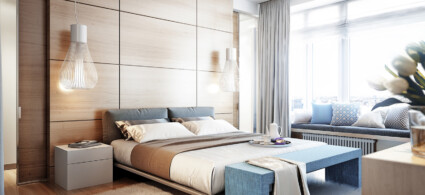
Mantua is a pleasant Lombard town that boasts a historic centre that is perfect for exploring on foot. Staying in the centre is certainly the best choice if you want to be close to the main monuments and if you want to fully experience the atmosphere of the city. Here you can find not only hotels but also small bed and breakfasts and apartments with a truly welcoming atmosphere.
Bear in mind that several properties are located within historic palaces that have been converted and offer visitors a truly unique experience. Alternatively, you might consider accommodation in the area near the station, which is an ideal solution if you want to stay in a central area that is also convenient to the railway.

The city of Mantua is easily accessible both by car and by public transport (train, bus or aeroplane). Those travelling by car can reach the city via the A22 motorway (Brenner Motorway), exiting at Mantua North (if coming from Brenner/Verona) or Mantua South (if coming from Modena/Bologna).
The city also has a railway station that provides connections to major cities in Lombardy, Veneto and Emilia-Romagna. From Mantua it is possible to reach Verona, Modena or Cremona in less than an hour, whilst Milan can be reached in approximately two hours by train.
The nearest airport is Verona’s Catullo Airport, approximately 40 km away, though it is not directly connected to the city. From the airport you need to reach Verona railway station and then take a train to Mantua. The Orio al Serio Airport in Bergamo, on the other hand, is approximately 130 km away.
What's the weather at Mantua? Below are the temperatures and the weather forecast at Mantua for the next few days.
Mantua is a charming town in south-eastern Lombardy, located not far from the borders with Veneto and Emilia-Romagna. The city lies 45 km from Verona, 70 km from Brescia and 160 km from Milan.



 Hotel
Hotel  Budget accommodations
  Apartments
  Family Hotel
  Luxury Hotel
  Resorts